

Our daily short-video pipeline has one quiet but critical step — turning speech into text (ASR) before editing, subtitling and quality checks. This post documents a small change with a big effect: reordering our 3-tier ASR fallback so the fastest respondent runs first.
The problem: ASR is an invisible bottleneck
Whenever the primary transcriber is slow or its queue is long, the whole day's batch drags behind it. We used to put the render GPU first, assuming GPU always wins. The real numbers said otherwise — whenever the GPU was busy rendering video, ASR jobs waited far longer than necessary.
The new 3-tier architecture
The idea is simple: let the idle, fast machine answer first, then fall back layer by layer — automatically.
| Tier | Machine | Role | Timing |
|---|---|---|---|
| 1 | Mac Mini (MLX) | Primary — fast, never fights the render GPU | ~3.4s first token |
| 2 | GPU server | First fallback | timeout 90s |
| 3 | CPU on the main box | Last fallback | timeout 300s |
The key is not just speed but workload separation — tier 1 draws from a different resource pool than rendering, so both queues move in parallel.
Measured results
After the swap (a single reorder inside one config file), the system reported:
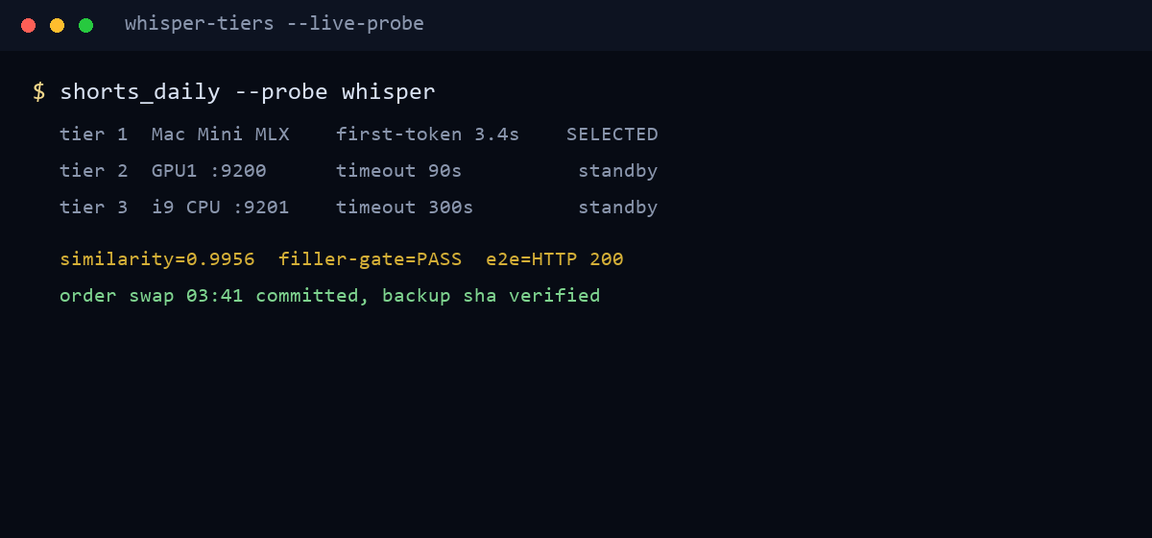
- Text similarity versus the reference transcript held at 0.9956 — identical to before the reorder, so quality was not traded for speed
- The filler-word gate passed across the full set
- End-to-end checks came back green
Lessons from the reorder
Three shortcuts for other teams:
- Measure before you believe — "GPU is faster" is only true when the GPU is idle. Numbers from the live system beat assumptions.
- Separate workloads; don't let them fight — rendering and transcription should not share one queue.
- Layered fallbacks with explicit timeouts — clear cutoffs let the system self-heal without a human watching.
The ASR tier sits behind our central model gateway, which handles queueing and access control for every AI service we run.
What's next
The next piece of this work is automatic audio quality gating before transcription (noise and level checks), so unusable jobs get rejected at the door instead of failing mid-queue. Results will be documented here.